
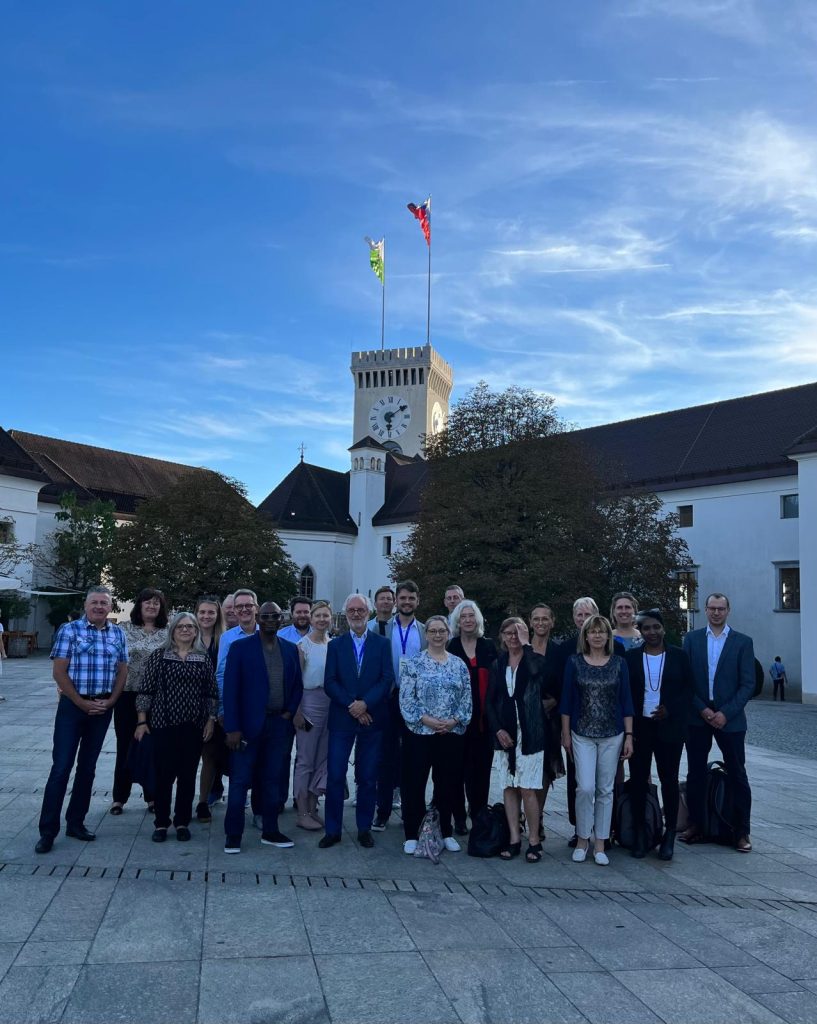
IRSPP 9 was held in Ljubliana, Slovenia
IRSPP9 examined Public Procurement’s role in crises. The Covid-19 pandemic required immediate responses from public procurement and highlighted an urgent need for better procurement preparation for the next wave of Covid or the next crisis – however, the next crises are already with us, including war in Europe, the climate crisis, the cost-of-living crisis and competition for scarce materials.
Our Research Question: What role should public procurement play in crises?
Empirical research was conducted in 3 connected research project phases – at the beginning, the middle, and the end of the Covid-19 crisis period.
The first project phase involved interviewing 58 senior public procurement practitioners about their response to the Covid crisis.
Analysis of the first project led to the design of the second project phase which involved interviewing 45 senior public procurement practitioners from 35 countries on how they recovered from the Covid crisis through their procurement of critical materials and supplies.
The third project phase built on analysis from the first two and involved the preparation and presentation of 13 case studies at a 3-day workshop in Ljubljana, Slovenia.
[1] Harland, C. M., Knight, L., Patrucco, A. S., Lynch, J., Telgen, J., Peters, E., Tatrai, T & Ferk, P. (2021). Practitioners’ learning about healthcare supply chain management in the COVID-19 pandemic: a public procurement perspective. International Journal of Operations & Production Management, 41,13,178-189.
Important lessons learned
The Covid-19 health pandemic has highlighted:
- The weaknesses we have in our current systems demonstrated that planning is critical – “the devil is in the detail” and the context is fundamental.
- We have learned that mission and strategy is essential for future crisis preparedness. At local and regional levels, we should prioritise relationship management with suppliers.
- Each country faced different supply problems which seems much due to the national and local response.
- We learned it is important to be honest about what isn’t working so that we can improve and collaborate with others.
- One of the major risks is that we don’t act on the lessons learned especially on intergovernmental collaboration and market intelligence and go back to business as usual.
- We learned the importance of having strategic stocks and how a central crisis committee can speed up the response.
- We now understand the importance of good data, but also how to analyse it.
In terms of skills and competences:
- The procurement profession is (still) not always recognised as very relevant.
- The people attracted to the profession are (were) often good in administrative processes, using templates, etc. But often not that good in thinking outside the box, liaising with external stakeholders, knowing the markets, and understanding how to procure in a crisis (e.g. paying a little more is OK if it reduces risks).
- Public buyers may not be trained in the required competences for procuring in a crisis and have no experience in procuring in a crisis. NB. There were some politicians who tried to use public procurement as ‘the hero in the crisis, without focusing on prior knowledge or skilled and experienced advisors.